Teaching Haiku Poetry
Links, Resources, Ideas
Indexed by
This webpage was last updated or weeded back in January, 2003.
A very high percentage of the links on this
webpage
are probably no longer working.
This webpage is posted for historical purposes only.
Please use other Haiku Directories for current information.
Teaching Haiku Poetry
2nd Grade ... 3rd Grade ... 4th Grade
... 5th Grade
6th Grade ... 7th Grade ... 8th Grade ... 9th Grade
10th Grade ... 11th Grade ... 12th Grade
General - Children ... General - Adult ... College
1,404,416 Webpages
[Excluding graphics]
Served to Readers From March 2000 - December 2003
Reviews and Comments about
the Poetry Notebooks of Michael P. Garofalo
Introduction to
International Haiku 35K
Monarch Haiku. An AskEric lesson plan by Jennifer Lindahl of Mankato State University.
Word Dance:
Haiku Writing Worksheet. For teachers working with children, grades 2-6.
Creating
and Presenting Haiku with Kid Pix 15K
Grass Sandals, The Travels of Basho. By Dawnine Spivak.
Illustrated by Demi. New York, Atheneum Books
for Young Readers, 1998. 36 pages.
Haiku Poetry - Poetry Pals: K-12 Student Publishing Poetry Project Edited by C. Markham.
Journey
to Japan Through Poetry. A detailed lesson plan by Patrice M.
Flynn.
Monarch
Haiku. An AskEric lesson plan by Jennifer Lindahl of Mankato
State University.
Oceans
- A Fact Haiku ArtsEdge lesson plan by Mary Beth
Bauernschub, 54K.
Poetry Lesson Plans for
Elementary School Teachers. Pro-Teacher.
Poetry Teachers Fun
activities, poems, ideas, lesson plans.
Can You Haiku? EDSITEment lesson plan, 28K.
Haiku Poetry Lesson Plan.
By Rebecca Gallagher. Butte County, California.
17K.
Haiku
Writing and Editing Project. Prepared by Randy Brooks.
Student Haiku -
Jones Valley Elementary School, Huntsville, Alabama.
Word Dance:
Haiku Writing Worksheet. For teachers working with children, grades 2-6.
Foot and Mouth
Haiku. Milburn Elementary School.
Haiku for You
Haiku Lesson Plan. By Anita Matson.
Haiku Lesson Plan: Primary
From: In the Moonlight a Worm.
Haiku Poetry Lesson Plan.
By Rebecca Gallagher. Butte County, California.
17K.
Haiku
Writing and Editing Project. Prepared by Randy Brooks.
Introduction to International
Haiku 35K
Johnson County Kids Haiku Poems.
Poetry Lesson Plans for
Elementary School Teachers. Pro-Teacher.
Haiku Poetry - Poetry Pals: K-12 Student Publishing Poetry Project Edited by C. Markham.
Haiku Writing and
Editing Workshop. Prairieland Advocates for Gifted Children.
Presented by
Randy M. Brooks.
"The Nature of Haiku." By Peter Rillero, JoAnn V. Vleland,
and Karen A. Conzelman. Science
and Children, November/December 1999, pp. 16-20.
Poetry Teachers Fun
activities, poems, ideas, lesson plans.
Stone Bench in an Empty Park.
Edited by by Paul B. Janeczko, and illustrated by Henri Silberman.
Orchard Books, 2000. 40 pages. For children, ages 9 -12.
Student Haiku
- Hillcrest School, Ellsworth, Wisconsin
Student Haiku -
Miles Avenue School, Huntington Park, California.
Word Dance:
Haiku Writing Worksheet. For teachers working with children, grades 2-6.
I Welcome Your Comments, Ideas, Contributions, and Suggestions
Cool Melons - Turn to Frogs: The Life and Poems
of Issa. Edited by Matthew Gollub, illustrated
by Kazuko G. Stone and Keiko Smith. Lee and Low Books, 1998. 40
pages. A children's book.
Create Your Own Pseudo-Haiku Poety. Created by Rodrigo de Almeida Siqueira.
A
Guide for Teaching Haiku. Written by Patricia Donegan and Kazuo
Sato. An excellent six
part lesson plan.
Haiku Lesson Plans,
Activities, Teachers' Guides. McREL Site.
Haiku Poetry Lesson Plan.
By Rebecca Gallagher. Butte County, California.
17K.
Haiku Poetry: Links, References, and Resources.
Compiled by Michael P. Garofalo. 200K+
Haiku Poetry - Poetry
Pals: K-12 Student Publishing Poetry Project Edited
by C. Markham.
Haiku
Writing and Editing Project. Prepared by Randy Brooks.
Haiku Writing: From
Caterpillars to Butterflies. By Brother Toby.
Haiku Writing Worksheet.
Word Dance.
Poetry
- Japan - Exploring Haiku. A 2Learn 'NetSplore Activity Page.
Sample Poetry Study Unit Outline
Haiku: From Sound to Meaning. Outline of a 2-3 week unit of
study.
Warrensburg-Latham
Sixth Grade Haiku Anthology
Bringing Haiku Back to Life. A three week unit involving Internet research, writing haiku, cultural studies, and creating a PowerPoint presentation. Good links page.
Concrete Poetry:
Links, Bibliography and Some Poems. 100K. By Michael P.
Garofalo.
Haiku, Chaiku, God Bless
You: Teaching Japanese Poetry Writing. By Glori Chaika.
Lyrical Lessons.
Harris Middle School, Shelbyville, Tennessee.
Painting
Poetry. By Angela Maria B. Cherubino.
Poetry Covers It All.
Integrating Poetry in All Curriculum Areas. By Merry G. Broughton.
Quotes about Poetry Short
quotations about the nature of poetry.
Sample Poetry Study Unit Outline
Haiku: From Sound to Meaning. Outline of a 2-3 week unit of
study.
Stone Bench in an Empty Park.
Edited by by Paul B. Janeczko, and illustrated by Henri Silberman.
Orchard Books, 2000. 40 pages. For children, ages 9 -12.
Start Writing Haiku
Provided by the Shiki Internet
Haiku Salon.
Teaching
Poetry in New Formats: To Intermediate Grade Students. By Maria
DiPalma Laudano.
Criteria
for a Successful Haiku
A Guide for Teaching Haiku. Written by Patricia Donegan and Kazuo Sato. A six part lesson plan.
Do
You Haiku? Haiku for teens. Lesson plan involving
research, journal, and a PowerPoint
presentation. Rubric included. 48K.
Haiku Moments and
Beyond. By JoAnn Dunnican. Detailed lesson plan. Emphasizes
technological literacy.
Haiku Poetry Teaching Kit.
Prepared by the British Haiku Society.
How to Write
Haiku. By Neca Stoller. Edited by Tom Boyle. Includes
instructions about writing
cinquain. Street
Saint Publications, 2000. 80 pages.
In the Middle: Writing, Reading, and Learning with Adolescents.
By N. Atwell. Portsmouth,
NH: Heinemann, 1987.
Kites and Flight:
The Art of Haiku Kathrine M. Grahame. 24K
Mrs. Smith's Poetry
Page Lot's of good ideas and links for
teaching poetry.
Poetry
- Japan - Exploring Haiku. A 2Learn 'NetSplore Activity Page.
Sample Poetry Study
Unit Outline Haiku: From Sound to Meaning. Outline of a 2-3 week
unit of study.
Sensei
Salon - Teaching Tools. Extensive haiku bibliography by Kristen Deming.
Excellent!! 150K+.
WHC Haiku
Junior. By DeVar Dahl. 40K+
African-American Poetry Unit By Mark Miazga.
A Guide
for Teaching Haiku. Written by Patricia Donegan and Kazuo Sato. A
six part lesson plan.
Haiku Lesson Plan - Secondary
From: In the Moonlight a Worm.
Haiku
Who? Writing Haiku Poetry: Lesson Plan and Rubric. By Kerry
Eisenmenger.
Integrating Technology into the
Teaching of Poetry. By Susan Bisson.
One Exercise.
By Timothy Russell.
Poetry
- Japan - Exploring Haiku. A 2Learn 'NetSplore Activity Page.
Poetry: Techniques &
Form. By John Sweeney.
Project #28: Hypertext
Haiku
Sample Poetry Study Unit Outline
Haiku: From Sound to Meaning. Outline of a 2-3 week
unit of
study.
Writing Haiku
Lesson Plan By B. Wu.
Non Western Art: Oriental Brush
Drawing & Haiku Poetry
Outta Ray's Head: The Poetry
Page
Poetry Covers It All.
Integrating Poetry in All Curriculum Areas. By Merry G. Broughton.
Show Don't Tell: Literal Images.
From: In the Moonlight a Worm.
Start Writing Haiku By David McMurray.
Creative Writing For Teens. By Diane Dobbs.
Environmental
Studies and Haiku
The Haiku Handbook: How to Write, Share, and Teach
Haiku. By William J. Higginson with
Penny Harter. Tokyo, Kodansha International, 1985. Glossary, index,
resources,
season words, 331 pages. A highly praised, and rightly so, guide to
Haiku.
Haiku in History: The Roaring Twenties.
By Deborah T. Aufdenspring.
Haiku Moments and
Beyond. By JoAnn Dunnican. Detailed lesson plan. Emphasizes
technological literacy.
Haiku Poetry: Links, References, and Resources.
Compiled by Michael P. Garofalo. 200K+
Hints: How to Write Haiku.
By Phil Adams.
Kites and Flight:
The Art of Haiku Kathrine M. Grahame. 24K
Self-Study Lessons.
From: In the Moonlight a Worm.
Show Don't Tell: Literal Images.
From: In the Moonlight a Worm.
Start Writing Haiku By David McMurray.
Teaching Poetry in High School.
By Albert B. Sommers.
Concrete Poetry: Links, Bibliography and Some Poems. 100K. By Michael P. Garofalo.
The Japanese Haiku Masters. Links,
References, Resources.
Poetry
- Japan - Exploring Haiku. A 2Learn 'NetSplore Activity Page.
Self-Study Lessons.
From: In the Moonlight a Worm.
Writing Haiku Lesson Plan By B. Wu.

General
Children and Teenagers
(Grades: 2-12)
Black Swan/White Crow. By Lewis J. Partrick. Atheneum, 1995
Children's Haiku Garden
Haiku poems and accompanying artwork from young children
around the world. An enjoyable and substantial site well worth a visit.
Edited by Ryo Suzuki.
The Classic Tradition of Haiku: An Anthology.
Dover Publications, Dover Thirft Edition, 1996.
Cool Melons - Turn to Frogs: The Life and Poems
of Issa. Edited by Matthew Gollub,
illustrated by Kazuko G. Stone and Keiko Smith. Lee and Low Books, 1998.
40 pages.
Cricket Never Does: A Collection of Haiku and Tanka.
By Myra Cohn Livingston.
Illustrated by Kees De Kiefte. Margaret McElderry, 1997. School and Library
Binding.
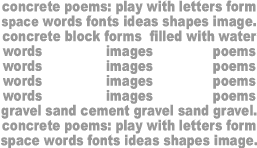
Concrete Poetry: Links, Bibliography and Some Poems
By Michael P. Garofalo. 100K+
Finding
Patterns in Haiku Lesson Plan
Forms of Poetry for Children
By Inez Ramsey. Eleven short forms are introduced. Very
good links.
Do
You Haiku? Haiku for teens. Lesson plan involving
research, journal, and a PowerPoint
presentation. Rubric included. 48K.
A
Guide for Teaching Haiku. Written by Patricia Donegan and Kazuo
Sato. An outstanding
website for teachers.
Haiku Exchange Project A
superior collection of haiku by students from many schools
around the world. Important!! Edited by Kenji Shiramizu.
The Haiku Gallery Haiku
for children. A web ring jumpsite.
The Haiku Handbook: How to Write, Share and Teach Haiku. By William
J. Higginson and
Penny Harter. Tokyo, Kodansha International, © 1985. Glossary, credits,
resources, index; 332 pages.
Teaching haiku in schools is covered in Chapters 11 and 12, pp. 151-180.
Haiku Lesson Plans,
Activities, Teachers' Guides. McREL Site.
Haiku of the Day.
Webmaster: Author Matt Cibula of Zino Press.
Haiku: One Breath Poetry Naomi Beth Wakan.
Canada, Pacific Edge Publishing, 2000.
ISBN 0-89346-846-0. Purchase
Haiku Poetry - Poetry
Pals: K-12 Student Publishing Poetry Project Edited
by Cheryl. Markham.
Haiku Poetry Teaching Kit.
Prepared by the British Haiku Society.
Haiku Resources for Teachers. New York, N.Y., Haiku Society of
America, ©2000.
Second Edition. A packet of materials designed for those teaching haiku to students
of
all ages (elementary school to adult).
Haiku: The Mood of Earth; My Own Rhythm. By Ann
Atwood.
Haiku Theme Page Resource and links for teachers.
Halloween Haikus
by children.
Haiku Resources.
By Mark Brooks. Excellent links to articles and web sites about
reading and writing haiku.
How to Write
Haiku. By Neca Stoller. Edited by Tom Boyle. Includes
instructions about writing
cinquain. Street
Saint Publications, 2000. 80 pages.
Internet School Library Media
Center - Haiku Page
Johnson County Kids Haiku Poems.
Junior World Haiku Club Mailing List
Kidz Poetry Page All
kinds of poetry by and for children are featured.
A Net of Fireflies: Japanese Haiku and Haiku Paintings.
Translated and edited by Harold
Stewart. Charles E. Tuttle, 1993. Mr. Stewart prefers to translate haiku poems
in the rhymed
couplet format. Some students might have more successs writing clever rhymed
couplets.
Poetry for Kids All kinds
of poetry by and for children are featured.
Poetry Lesson Plans for
Elementary School Teachers. Pro-Teacher.
Poetry Pals All
kinds of poetry by and for children are featured.
Poetry Pals:
The K-12 Student Poetry Publishing Project All kinds of poetry by
and for
children are featured.
Poetry Teachers Fun
activities, poems, ideas, lesson plans.
Pro Teacher: Haiku Poetry
Lesson plans.
Quotes about Poetry Short
quotations about the nature of poetry.
Stone Bench in an Empty Park.
Edited by by Paul B. Janeczko, and illustrated by Henri Silberman.
Orchard Books, 2000. 40 pages. For children, ages 9 -12.
Teaching Haiku Poetry:
Links, Resources, References. By Michael P. Garofalo. 64K+
Teaching Literature and Poetry in Schools. A Bibliography.
Teaching Through Poetry: Writing and the Drafting Process. By George
Marsh. London,
Hodder and Stoughton, © 1988.
WHC Haiku Junior.
By DeVar Dahl. 40K+
Adult and College Writers
A Ha! Poetry. Coordinated by Jane Reichhold. Poetry, articles, links, information, participation options.
The Art of Haiku. By
Gerald England.
Author Index to Haiku Poems on the Internet.
Links to over 125 haiku poets, scholars, editors,
and webmasters. By Michael P. Garofalo. Updated monthly. Open
Directory - ![]()
Beyond the Haiku
Moment: Basho, Buson and Modern Haiku Myths. By Haruo Shirane.
Brooks' English-Language Haiku
Web Site. Maintained by Randy and Shirley Brooks.
Excellent presentation of featured poets, magazines, books, and poems. Highly
informative!!
Useful for teachers. Excellent on-line books featurring haiku with photographs by
Michael Dylan Welch and Garry Gay; and, artwork by John Polozzolo with haiku.
Brooks Books publishes Mayfly magazine and many other fine haiku books.
A Top-Notch Haiku web site!
Cloud Hands: Tai Chi Chuan and Qi Gong
Cold Mountan Buddhas:
Han Shan
Concrete Poetry: Links, Bibliography and
Some Poems By Michael P. Garofalo.
100K+
Contemporary Haiku:
Origins and New Directions. By A.C. Missias.
Cuttings:
Short poems, haiku, couplets, and senryu by Michael P. Garofalo. 1MB+.
Arranged
by the months of the year.
A Dictionary of Haiku:
Classified by Season Words with Traditional and Modern Methods
By Jane Reichhold.
Environmental
Issues: Scoring Rubric for Poetry
For Students. By David Lanoue.
Forms in English Haiku.
By Keiko Imaoka.
Fragment and Phrase Theory.
By Jane Reichhold. Ms. Reichhold's website offers many
other articles that will be useful to teachers.
Guides and Directories to Haiku on the Internet
Guidelines: The Isn'ts of
Haiku By Lorraine Ellis Harr. A fine definition
by negation.
Haiku Discussion Groups on the Internet
Haiku
FAQ. By William J. Higginson.
The Haiku Habit
By Jeanne Emerich. Good tips for beginners writing haiku.
The Haiku
Handbook: How to Write, Share, and Teach Haiku. By
William J. Higginson with
Penny Harter. Tokyo, Kodansha International, 1985. Glossary, index,
resources, season words, 331 pages.
A highly praised, and rightly so, guide to Haiku. Review1. Review2. Mr.
Higginson is the
editor for the Open Directory
section on haiku poetry.
Haiku
in Euducation By Dr. Randy Brooks, Millikin
University, Illinois. 31K
Haiku in English in North
America. By George Swede.
Haiku: One Breath Poetry Naomi Beth Wakan.
Canada, Pacific Edge Publishing, 2000.
ISBN 0-89346-846-0. Purchase
Haiku Poetry: Links, References, and Resources.
Compiled by Michael P. Garofalo. The most
comprehensive and up-to-date collection of links to haiku resources on the
Internet. This site provides
both title and author indexing of Internet resources, some topical arrangements of links,
short descriptions
of website offerings, and Amazon.com pointers to relevant book titles. Updated
weekly. 200K+
Haiku Resources.
By Mark Brooks. Excellent links to articles and web sites about reading
and writing haiku.
Haiku:
The Universality of Now. Lecture by Randy M. Brooks.
Haiku
World: An International Poetry Almanac. By
William J. Higginson. Tokyo, Kodansha
International, 1996. Subject index (pp.396-407), author index, 407 pages. An
outstanding haikai saijiki
which includes over 1,000 poems by over 600 poets from 50 countries. Haiku are
creativley organized
by broad topics (e.g., animals, earth, heavens, humanity, holidays, plants, etc.) within
each of the four
seasons, new year, and all year categories. The best English language saijiki reference book. The
companion volume to The
Haiku Seasons: Poetry of the Natural World.
Hints: How to Write Haiku.
By Phil Adams.
History of Haiku
By Ryu Yotsuya. Informative short essays on 10 famous Japanese Haiku
poets.
Hokku-Way. A
collection of over 260 notes and short essays about writing haiku by David Coomler.
How to Write Haiku.
By Gerald England.
How to Write
Haiku. By Neca Stoller. Edited by Tom Boyle. Street Saint Publications,
2000. 80 pages.
In the Moonlight a Worm.
"This website offers teachers and students an introduction to
writing
haiku poems, a chance to study the history and nature of haiku poetry and an introduction
to the
fundamental principles of creative writing. It is free and non-profit making. If you are a
teacher,
you may download the lesson plans and photocopiable poem sheets and use them with your
classes." Presented by George Marsh. Lesson Plans for teachers in primary
and secondary
schools, and plans for self-study. The site includes short articles, a bibliography,
student work,
and many ideas for students and teachers of poetry. Mr. Marsh is the author of
Teaching
Through Poetry: Writing and the Drafting Process, published by Hodder and Stoughton
in 1988.
Introduction to
Haiku Writing and appreciation of haiku. Shiki Workshop
notes.
An Introduction to Haiku.
By John Barlow.
The Japanese Haiku Masters. Links,
References, Resources.
Juxtaposition
in Haiku: A Conversation. An e-mail conversation between Lori
Laliberte-Carey and Ferris Gilli.
Dhugal J. Lindsay's
Haiku Universe. Numerous interesting essays for teachers of haiku.
Laughter in
Japanese Haiku By Nobuyuki Yuasa.
Looking at Haiku.
By Elizabeth St. Jacques.
Mail Lists On-Line for Sharing Ideas and Haiku
Open
Directory Haiku Poetry Links. Links selected by William J.
Higginson, aka "wordfield,"
renowned haiku authority. Provides indexing by categories: general haiku, personal
haiku pages,
linked forms, Sijo, Tanka, and psuedo haiku. Updated monthly. The Open
Directory Index is
used by AOL, Hot Bot, Lycos, and Google.
Poetics: A Personal Statement.
Part I: Haiku. By Janice M. Bostok.
Poetry in the Light.
Excellent articles and quality poetry.
Quotes about Poetry Short
quotations about the nature of poetry.
Reference Texts.
A useful index to essays about haiku available on the Internet. Indexed by Serge
Tome.
Jane Reichhold's Articles on
Writing Haiku Lots of good material to learn from at this
extensive site.
Renku Seminar.
By Paul MacNeil.
Rhythm in Haiku?
By Elizabeth St. Jacques.
Season
Word List - Yuki Teikei Haiku Society
Seeds from a
Birch Tree: Writing Haiku and the Spiritual Journey.
By Clark Strand. New
York, Hyperion, 1997. 188 pages. ISBN:
0786883235. The author was a Zen Buddhist monk
for many years, before becoming a family man and householder in the Eastern U.S.. A
gentle and
warmhearted introduction to writing haiku as a way of being a more creative and insightful
person.
Emphasis is upon a 5-7-5 style form.
Sensei
Salon - Teaching Tools. Extensive haiku bibliography by Kristen Deming.
Excellent!! 150K+.
Self-Study Lessons.
From: In the Moonlight a Worm.
|
Short Poems by Michael P. Garofalo
Speculations. By Robert Speiss.
Stalking the Wild Onji.
By Richard Gilbert. Haiku research
papers.
Start Writing Haiku By David McMurray.
Tapping the Common
Well. By Jim Kacian.
Teaching Haiku in Higher Education. By Randy Brooks,
Millikan University. 30K.
Teaching Haiku Poetry: Links, Resources, References. By Michael P. Garofalo. 49K+
Teaching Poetry:
Generating Genuine, Meaningful Responses. By Charlie Frankenbach.
Tercets Selected verses and
links.
The Three Hundred
Missing Poems of Han Shan. By Mazie and Robert O'Hearn.
Tips for Teaching Poetry
Toward an
Aesthetic for English-Language Haiku. By Lee Gurga. 54K+.
Want Fries with Those Haiku?
By Michael Dylan Welch.
Writing Haiku
Lesson Plan. By Mary Louise Ross.
Zen Poetry.
Extensive links and bibliography, a large collection of selected quotes, notes,
special studies, and webpages on noted Zen poetry scholars and translators, e.g., R. H.
Blyth,
Lucien Stryk, etc.. 310K+ By Mike Garofalo.
The Zip:
An Analogue to the Japanese Haiku. by John E. Carley. Definition and
examples.
Zip: Form, Freedom
and Phonics. An alternative approach to the Haiku in English. By
John E. Carley. 70K.
The daily life of the heart is the
deeply swelling tide;
and ku are the waves on its surface ...
my haiku are the records of my life.
- Takahama Kyoshi (1874-1959), Haiku Diary (Ku Nikki)
I was thinking then about what
Kerouac and I thought about
Haiku - two visual images, opposite poles, which are connected
by a lightning in the mind. In other words, "Today's been a good
day; let another fly come on the rice." Two disparate images,
unconnected, which the mind connects. ... I meant again if you
place two images, two visual images side by side and let the mind
connect them, the gap between the two images the lightning in the
mind illuminates. It is the Sunyata (Buddhist term for blissful empty
void) which can only be know by living creatures.
- Allen Ginsberg. From a New York Quarterly Craft
interview with Mr. Ginsberg,
published in The Craft of Poetry, edited by William Packard, (Doubleday,
1974).
A haiku is the expression of a
temporary enlightenment,
in which we see into the life of things.
Reginald H. Blyth, 1898-1964
Personally, I would prefer more
discussions of these techniques of using riddles,
associations, contrasts, oneness, sense-switching, narrowing focus, metaphor and
simile (yes! judicially and in moderation), sketch (Shiki's shasei), double
entendre,
close linkage, leap linkage, pure objectivism, and more, rather than the mysterious
idea that if one has a true haiku moment the resulting ku will be an excellent haiku.
This is pure rot. The experience is necessary and valid (and probably the best part
of the haiku path), but writing is writing is a skill and craft to be learned.
- Jane Reichhold, Frogpond, XXI:2, p. 75.
Haiku: 1) An unrhymed Japanese
poem recording the essence
of a moment keenly perceived, in which Nature is linked to
human nature. It usually consists of seventeen onji.
2) A foreign adaptation of 1, usually written in three lines
totaling fewer than seventeen syllables.
- Haiku Path
Senryu: 1) A Japanese poem
structurally similar to the
Japanese haiku but primarily concerned with human
nature, often humorous or satiric. 2) A foreign
adaptation of 1.
- Haiku Path
The primary purpose of reading and
writing haiku is sharing
moments of our lives that have moved us, pieces of experience
and perception that we offer or receive as gifts. At the deepest
level, this is the one great purpose of all art,
and especially of literature.
- William R. Higginson, The
Haiku Handbook: How to Write, Share, and Teach Haiku.
During the eighteenth century a
satirical form of haiku called senryu
was developed by Karai Senryu (1718-1790) as a kind of "mock haiku"
with humor, moralizing nuances, and a philosophical tone, expressing
"the incongruity of things" more than their oneness, dealing more
often with distortions and failures, not just with the harmonious
beauty of nature...
- Yoshinobu Hakutani and Robert L. Tener, Haiku: This
Other World
There is an affinity which everyone
must have noticed between
poetry - certain kinds and moments of it - on the one hand, and
such succinct forms as the proverb, the aphorism, the riddle, on
the other. Poetry, on many occasions, gathers the latter under
its name. But it seems to me likely that the proverb and its
sisters are often poetry on their own, without the claim
being made for them.
- W.S. Merwin, (Asian Figures), 1973
An artist is a person who lives in
the triangle which remains
after the angle which we may call common sense has been
removed from this four-cornered world.
- Natsume Soseki, 1867-1916
Real haiku is the soul of poetry.
Anything that is not actually
present in one's heart is not haiku. The moon glows, flowers
bloom, insects cry, water flows. There is no place we cannot
find flowers or think of the moon. This is the essence of haiku.
Go beyond the restrictions of your era, forget about purpose or
meaning, separate yourself from historical limitations -- there
you'll find the essence of true art, religion, and science.
- Santoka Taneda
Look at the finest of the classics
and the finest contemporary haiku,
and I believe you will find a common thread running through them all.
This thread might be characterized as having a dedication to
truthfulness combined with a lack of self-consciousness.
- Lee Gurga, Toward an Aesthetic for
English-Language Haiku, 2000
A haiku is the expression of a temporary enlightenment,
in which we see into the life of things.
- R. H. Blyth
The art of poetry ... is like sound
in the air,
the color of things, the moon reflected in water,
the image in a mirror. Although words in a poem may have
their limitations, their meaning extends illimitably ...
- Wei Ch'ing-chin, Sung Dynasty
I propose that the "Western
Haiku" simply say alot in three
short lines in any Western language. Above all, a haiku must
be very simple and free of all poetic trickery and make a little
picture and yet be as airy and graceful as a Vivaldi Pastorella.
- Jack Kerouac
The very best haiku encompass a moment of insight, and do
so
in resonant language in an accessible and appropriate form. It
takes a very great artist to be deep and simple at the same time,
and not leave her thumbprint all over the poem. That is why it is
adjudged a great feat to create a perfect haiku--not just because
one has seen the truth, but because one has communicated it.
- Jim Kacian, Tapping the Common Well
Haiku is more than a form of poetry;
it is a way of seeing the world.
Each haiku captures a moment of experience; an instant when the
ordinary suddenly reveals its inner nature and makes us take a
second look at the event, at human nature, at life.
- A.C. Missias
To express an image or two so well
that the reader "sees" them in
his/her mind and then! you add another image that demands a leap
or twist so the two previous images are seen in a new relationship
(maybe even your metaphor, if you are lucky). An additional twist
is to have images plus leap which reveal some deep philosophical
truth or ideal without having to speak of it. Poetry is written
vision. You have to show new ways of seeing things
to be a real poet.
- Jane Reichhold, Another Attempt to Define Haiku
These are some of the characteristics
of the state of mind
which the creation and appreciation of haiku demand:
Selflessness, Loneliness, Grateful Acceptance, Wordlessness,
Non-intellectuality, Contradictoriness, Humor, Freedom,
Non-morality, Simplicity, Materiality, Love, and Courage.
- R. H. Blyth, Haiku, 1949, Volume One, p.
154
From the very start, largely due to
Basho, haiku at its best was seen as
revelatory, possessing qualities in common with other arts based on an
essentially Zen aesthetic: simplicity, directness, naturalness,
produndity.
And each poem had its dominant mood, one of four subtly categorized:
sabi (isolation), wabi (poverty), aware (impermanence), yugen
(mystery).
To haiku's finest artists its brevity was seen less as a barrier than
challenge to the imagination, demanding that however broad in
implication the poem would have to be of single impact.
- Lucien Stryk, The Dumpling Field, p. xviii
Images haunt. There is a whole
mythology built on this fact: Cezanne painting
until his eyes bled. Wordsworth wandering the Lake Country hills in an
impassioned daze. Blake describes it very well, and so did a colleague of Tu Fu
who said to him, "It is like being alive twice." Images are not quite
ideas, they
are stiller than that, with less implications outside themselves. And they are
not
myth, they do not have that explanatory power; they are nearer to pure story.
Nor are they always metaphors; they do not say this is that, they say this is.
- Robert Hass, Twentieth Century Pleasures
So, once again, I echo Basho's cry: "Return to
nature!" In my poems,
may I never fail to demonstrate that essential haiku sensitivity to the
world around me, and build, each by each, small shrines to the
consciousness that says there is something larger, and more
important, than this mere self that does the
looking and the scribbling.
- William J. Higginson

Haiku Poetry
Links, References, Guides
Author Index to Haiku Poetry On the Internet
Quotes for Gardeners
Quotes, Sayings, Proverbs, Poetry, Maxims, Quips,
Cliches, Adages, Wisdom
A Collection Growing to Over 2,700 Quotes Arranged by Over 130 Topics
Many of the Documents Include Recommended Readings and Internet Links.
Compiled by Michael P. Garofalo
Distributed on the Internet by Michael P. Garofalo
E-mail Mike Garofalo in Red Bluff, California
A Short Biography of Mike Garofalo
Garofalo's Poetry Notebook II
Teaching Haiku Poetry
A
Note on the Maintenance of this Poetry Web Page
Cloud Hands: T'ai Chi Ch'uan and Qigong
Cuttings: Poems by Michael P. Garofalo
![]()