Zen
Poems
Selected Quotations
II
Earth, mountains, rivers - hidden in this nothingness.
In this nothingness - earth, mountains, rivers revealed.
Spring flowers, winter snows:
There's no being or non-being, nor denial itself.
- Saisho (? - 1506)
Zen Poetry: Let the
Spring Breeze Enter, p.32
Translated by Lucien Stryk and Takashi Ikemoto
The true man of no rank -
What a piece of dry crap he is!
- Hung-Chih, 1145
Awakening in the
Stream, p. 181
A special transmission outside the scriptures;
No dependence upon words and letters;
Direct pointing at the soul of man:
Seeing into one's nature and the attainment of Buddhahood.
-
Bodhi-Dharma, c 570
Found in Zen Buddhism,
1956, p. 61
By D. T. Suzuki
Buddha preached in the twelve divisions,
each
division full of purest truth.
East
wind -- rain comes in the night,
making all the forest fresh and new.
No
sutra that does not save the living,
no
branch in the forest not visited by spring.
Learn
to understand the meaning in them,
don't
try to decide which is "valid," which is not.
- Ryokan, 1758-1851
Ryokan: Zen Monk - Poet of Japan, 1977, p. 103
Translated by Burton Watson
To what shall
I liken the world?
Moonlight, reflected
In dewdrops.
Shaken from a crane's bill.
-
Dogen, 1200 - 1253
The
Zen Poetry of Dogen
Translated by Steven Heine
The world? Moonlit
Drops shaken
From the crane's bill.
- Dogen
Zen
Poems of China and Japan, p. 81
Translated by Lucien Stryk
Zen Poetry: Selected Quotations I
The thief
Left it behind -
The
moon at the window.
- Ryokan, 1758-1831
Dewdrops on a Lotus
Leaf,
Translated by John Stevens
In ten directions everywhere, throughout the sea of lands,
Every hair-tip encompasses oceans of past, present and future.
So, too, there is a sea of Buddhas, a sea of Buddha lands;
Pervading them all, I cultivate for seas of endless time.
- The Flower Adornment
Sutra
Translated by The Buddhist Text Translation Society
Zen Poetry: Links, Bibliography and Resources
To study the buddha way
is to study the self.
To study the self is to forget the self.
To forget the self is to be enlightened by the ten
thousand dharmas.
To be enlightened by the ten thousand dharmas is
to free
one's body and
mind and those of others.
No trace of enlightenment remains, and this
traceless
enlightenment is
continued forever.
- Dogen, 1200 - 1253
Genjokoan: Enlightenment as Everyday Life
Translated by Hakuyu Taizan Maezumi
Found in Entering the Stream,
1993, p. 206
Edited by Samuel Bercholz and Sherab Chodzin Kohn
Zen Poetry: Selected Quotations I
But I say unto you,
Take this staff just as a staff;
Movement is movement;
Sitting is sitting,
but don't wobble
under any circumstances!
My staff has turned into a dragon
and swallowed up the whole world.
Where are the poor mountains and rivers and great earth now?
Vasubandhu happened to transform himself
Into a staff of chestnut wood, and,
Striking the earth once,
All the innumerable Buddhas were released
from their entangling words.
-
Yun-men Wen-yen, (Ummon), 864-949
Sermons
Translated by R. H. Blyth
Found in Zen and
Zen Classics: Selections, p. 252
Edited by Frederick Franck
If you are a poet, you will see clearly that there is a
cloud floating in this
sheet of paper. Without a cloud there will be no water; without water,
the trees cannot grow; and without trees, you cannot make paper. So
the cloud is in here. The existence of this page is dependent upon the
existence of a cloud. Paper and cloud are so close.
- Thich Nhat Hahn
Engaged
Buddhism
Found in Entering the Stream,
1993, p. 248
Edited by Samuel Bercholz and Sherab Chodzin Kohn
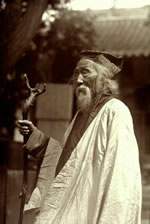
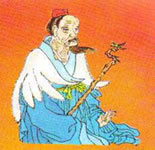
Shifu Miao Zhang Points the Way
"Mayoku walked around his old Daoist friend, Shifu
Miao Zhang (师傅妙杖), three times
and then thumped his staff on the ground.
Maio Zhang stood up, walked around Mayoku once, tapped his cane three times on
the wall, and said "The power of the wind can topple trees and is gone by
morning. My cane can cut through the wind."
Zen Master
Hakuin Ekaku asked his Daoist friend, Shifu Miao Zhang, "Two hands clap and there is a sound; what is the sound of one
hand?"
Miao Zhang picked up his beautiful cane in one hand, and then quickly tapped it
eight times on the floor.
Hakuin Ekaku smiled and said, "Indeed, Miao Zhang's cane is louder than the
sound of one hand, but it must be polished more."
Zen Master
Baqiao told his old friend, "If you have a
staff, I will give you a staff; if you have no staff, I will take your staff
away."
His friend, Shifu Miao Zhang, replied "I have a cane and you don't. Would you like to borrow yours?"
Baqiao replied, "Miao Zhang, you will have to walk into Hell!"
Miao Zhang raised his eyebrows and said, "Well, Baqiao, then I will need to
borrow my cane
for the long hot walk. Sorry, but I can't lend yours to you."
Gathering together in an orchard of blooming sweet lime trees, the students
waited for their esteemed teacher, Kasyapa. Slowly walking down the dirt
path, relying on his danda walking staff for balance, Kasyapa joined his students.
He sat quietly for a long time, enjoying the fragrance of the lime blossoms.
Finally, he raised his danda staff. Everyone stared at Kasyapa - serious,
intent, focused, and silent. Only Shifu Miao Zhang smiled, and then lifted his
cane and pointed at a lime blossom. Kasyapa pointed his danda at Shifu Zhang. Another transmission
was completed. The sacred thread remained unbroken.
Zen Master
Seung Sahn held up his staff in front of old Shifu Miao Zhang, and said "Then,
Miao Zhang, what are this staff, this sound and your mind? Are they the same or
different? If you say "same," I will hit you thirty times. If you
say "different," I will also hit you thirty times. Why?"
Miao Zhang lifted his cane slowly and pointed it at Seung Sahn's face, and
then he said "Don't know! Same or different, nobody can hit the sound of our
minds."
Zen Master
Shuzan held out his short staff in front of his Daoist friend, Shifu Miao Zhang, and said "If you call this a short staff, you oppose its reality and
are clinging. If you do not call it a short staff, then you ignore the fact. Now
what do you wish to call this?"
Miao Zhang smiled, dropped and pointed to his cane, and said "Yesterday it was a wooden walking stick that
helped without speaking. Tomorrow it may become firewood, crackling in the
flames."
Shifu Miao Zhang was waiting by a riverbank with a group of very poor women
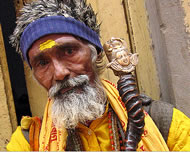
and children for a small ferry boat. Suddenly, a naked Digambar Sadhu appeared.
The Sadhu, holding a sword in his hand, proceeded to walk across the rushing
water of the river, and then walk back across the water towards Miao Zhang.
Everyone was stunned and in awe, but fearful of the powers of the Sadhu. The Sadhu
asked Miao
Zhang, "Foreigner, my gleaming sword has great magical powers, what can your crooked staff
do?" Miao Zhang said, "It enabled my wobbly legs to walk to work each day,
and to earn enough money to pay for all of us here to ride the ferry boat safely across
these dangerous waters. When we get to the other shore, can I buy you some
food and clothes, holy man?"
Zen Master Yunmen Wenyan and Shifu Miao Zhang were walking
together in the hills behind the monastery one cloudy autumn afternoon. It
began to rain steadily on the two old friends. Yunmen said, “My staff has
changed into a dragon and is swallowing up the heaven and earth. So, my friend,
where do mountains, rainfall, rivers and the great earth come from?”
Miao Zhang was quiet for awhile, stopped on the trail, and then held his cane
in his hand with the tip pointing to the sky. He said, “Yunmen, as for the
source of their coming, the tip of my cane points to the fecund depths of vast
emptiness, the crook end to the endless inter-marriages of ten thousand
realities, and my hand grasps the heartwood of the ordinary mind. So, my friend, Yunmen, where are they all going?”
Master Tung Kwo asked Sifu Miao Zhang, " Show me where the Tao is to be found."
Miao Zhang replied, "There is no place my cane or my mind goes or rests where
the Tao
cannot be found."
Zen Master
Ummon held up his staff in front of his Daoist friend, Shifu Miao Zhang, and said "This staff leapt up to the Eighth Heaven into the hands of the lame Zhong Kui who used it to awaken the Green
Dragon in the Eastern Sea."
Miao Zhang said, "Ummon your poetry is lovely, but my gnarled cane cannot hear you."
The powerful tribal chief, Aaron, once told Shifu Miao Zhang that
"Our tribe's god is very powerful and helps us defeat others. I once threw
my staff on the ground and it turned into venomous snakes. Another time, I
shook my staff in anger and made all the water in the wells and creeks turn into
blood."
Miao Zhang looked at Aaron and softly said, "I've used my cane to dig up roots to feed
some
hungry children. Fortunately, chief, our gentle gods mostly leave us alone."
Toju Zenchu brandished his staff before Daoist Shifu Miao Zhang
and challenged him "Miao Zhang, speak and you get
whacked with Nanten's
staff.
Do not speak and you still get whacked with Nanten's staff."
Shifu Zhang stood up quickly, lifted his cane
strongly in defense, and
quietly said, "Yunmen's shit stick stinks and Nanten's staff is cracked! I am leaving now to take my
evening walk. Goodbye."
- Michael P. Garofalo, Way of the Short Staff
(How would you answer these koan riddles like the old Daoist, Shifu Miao Zhang? Can you share any other stories where a staff or cane are part of the tale? I have included many of these stories in this webpage. Thanks!)
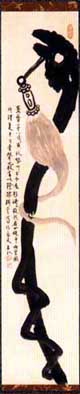
Zen Master Hakuin (1686-1768) painted a Dragon Staff with horsehair whisk
attached.
He would give this painting to his lay students who passed the Zen koan,
"What is the sound of one hand clapping."
Spirituality - Meditations Along a Garden Path
All that's visible springs from causes intimate to you.
While walking, sitting, lying down, the body itself is complete truth.
If someone asks the inner meaning of this:
"Inside the treasury of the dharma eye a single grain of dust."
- Dogen, 1200 - 1253
Moon in a Dewdrop,
p. 218
Translated by Kazuaki Tanahashi

Lucien Stryk: My final question concerns something which interests
us both
so much, Zen Poetry. Would you agree that enlightenment and death poems
of the masters, Chinese and Japanese, are the most important expressions in
the literature of Zen?
Roshi Gempo Nakamura: I would indeed. Especially the death poems, which
give the very essence of life, a brush of wind, and are often pondered like
koans by students of Zen. We have always learnt from them; they are
infinitely precious. You are right to be interested in them.
-
Zen
Poetry: Let the Spring Breeze Enter, 1995, p. xxi
Translated by and edited by Lucien Stryk and Takashi Ikemoto
Zen Poems: Links, Bibliography, Resources, Notes
Only the idea of self remains
Floating on a sea of cells;
Only heartbeats short of eternity
In breath after breath we dwell.
- Mike Garofalo, Above the Fog
Nothing remains
Of the house that I was born in--
Fireflies.
- Santoka, 1882-1940
Mountain Tasting:
Zen Haiku by Santoka Taneda, 1980, p.48
Translated by John Stevens
However looked at,
it's a world
to be loathed --
but as long as you live here
I'm drawn to it!
- Saigyo, 1118 - 1190
Saigyo: Poems of a Mountain Home, p. 179
Translated by Burton Watson
The secret of the receptive
Must be sought in stillness;
Within stillness there remains
The potential for action.
If you force empty sitting,
Holding dead images in mind,
The tiger runs, the dragon flees --
How can the elixir be given?
- Sun Bu-er, Chinese Zen-Taoist
Woman
The Perfect Way knows no difficulties
Except that it refuses to make preferences;
Only when freed from hate and love,
It reveals itself fully and without disguise;
A tenth of an inch's difference,
And heaven and earth are set apart;
If you wish to see it before your own eyes,
Have no fixed thoughts either for or against it.
- On
Believing in Mind, Sosan Canchi Zenji
Cloud Hands: Taijiquan and Qigong
When the mind is at peace,
the world too is at peace.
Nothing real, nothing absent.
Not holding on to reality,
not getting stuck in the void,
you are neither holy or wise, just
an ordinary fellow who has completed his work.
- Layman Pang-yun
(740-808)
The Enlightened
Heart, Edited by Stephen Mitchell, p. 34
If you ignore its profundity,
you can never practice stillness.
Like the Great Void, it is Perfect and lacks nothing,
nor has any excess.
If you discriminate,
you will miss its suchness.
Cling not to external causes,
nor stay in the Void.
Differentiation ceases if you can be impartial.
Stillness comes when all disturbances are stopped,
clinging to stillness is also a mistake.
If you cling to opposites,
how will you know the One?
- Third Patriarch of Zen
Have Faith in
Your Mind
No tranquilization, No disturbance,
No sitting, No meditation ...
This is the Tathagata's Dhyana.
The five Skandhas are not realities;
The six object of sense are by nature empty.
It is neither quiet nor illuminating;
It is neither real nor empty;
It does not abide in the Middle Way;
It is not-doing,
It is no-effect-producing;
Yet, functioning with the utmost freedom:
the Buddha-nature is all inclusive.
- Yung, a student of Hui-neng (Ts'ao-ch'i), the Sixth
Patriarch of Zen
Zen Buddhism: Selected Writings of D. T. Suzuki, p. 169.
Emptiness in Full Bloom: Flowers in the Sky (Kuge)
Zen Poetry: Selected Quotations
Compiled by Michael P. Garofalo
Poetry Notebook III of Mike Garofalo
Zen Poetry: Selected Quotations II
Available on the Net since January, 2000.
April 8, 2005
Cloud Hands: Tai Chi Chuan and Qi Gong